
Canadian Citizenship Eligibility: Who Can Apply
If you've been living in Canada as a permanent resident, there's a good chance you're wondering when you can finally apply for citizenship and what it actually takes to qualify. The rules are more specific than most people expect, and small details (like exactly how your days in Canada are counted) can move your eligibility date by months. Here's a clear breakdown of who qualifies and what the government looks for.
The core requirement: permanent residence and physical presence
To apply for Canadian citizenship as an adult, you generally need to be a permanent resident (PR) of Canada. Your PR status must be valid and in good standing, meaning you can't be under review for fraud, subject to a removal order, or have unfulfilled conditions attached to your status. You don't need a valid PR card in hand to apply, but you do need to actually hold PR status.
The headline rule is physical presence. You must have been physically present in Canada for at least 1,095 days (three years) during the five years immediately before the date you sign your application. Those days don't have to be consecutive, and short trips abroad are completely fine, as long as the total adds up.
There's a helpful wrinkle for some applicants. Time you spent in Canada before becoming a permanent resident, for example as a student, worker, or protected person, can count toward your total, but each of those days only counts as a half-day, up to a maximum of 365 days credited. The official IRCC website has a free physical presence calculator that does this math for you, and I'd strongly recommend using it rather than estimating, because miscounting is one of the most common reasons applications get returned.
Tax filing, language, and the knowledge test
Meeting the presence requirement is necessary but not sufficient. A few other conditions apply to most adult applicants.
Income tax. You need to have met your income tax filing obligations for at least three of the five years that fall within your eligibility period. This is tied to your physical presence window, and it trips people up if they assumed filing wasn't required because they earned little or nothing.
Language ability. If you're between 18 and 54 when you apply, you must show adequate knowledge of English or French. In practice this means a level roughly equivalent to being able to handle everyday conversation. You prove it with accepted documents such as certain language test results, transcripts from schooling in English or French, or proof of completing specific government-funded language programs.
The citizenship test and knowledge of Canada. Applicants in that same 18-to-54 age range also need to demonstrate knowledge of Canada's history, geography, government, and the rights and responsibilities of citizenship. This is assessed through the citizenship test, which is based on the official government study guide. The test is free to study for, and the guide is available on the official IRCC website.
If you're under 18 or 55 and older, the language and knowledge-test requirements generally don't apply to you, which simplifies things considerably for younger and older applicants.
Children, and people who don't need to apply at all
Not everyone has to go through the full grant process. Minor children can be included on a parent's application or applied for separately, and the residency, language, and test requirements are handled differently for them.
It's also worth knowing that many people are already citizens without realizing it. If you were born in Canada, you're almost always a citizen automatically. And if you were born outside Canada to a Canadian parent, you may have been a citizen by descent from birth, meaning you wouldn't apply for a grant of citizenship at all, you'd instead apply for proof of citizenship (a citizenship certificate). Citizenship rules for people born abroad to Canadian parents have changed over the years and remain an area of active law, so if your situation involves a Canadian parent, check your specific circumstances on the official IRCC website before assuming you need to start from scratch.
What can hold you back, and how to apply
A few things can make you ineligible even if you meet the presence requirement. Serious criminal history, a current prohibition, certain immigration enforcement matters, or having previously had your citizenship revoked can all create a bar, sometimes temporary. Time spent serving a sentence generally doesn't count toward your physical presence, either.
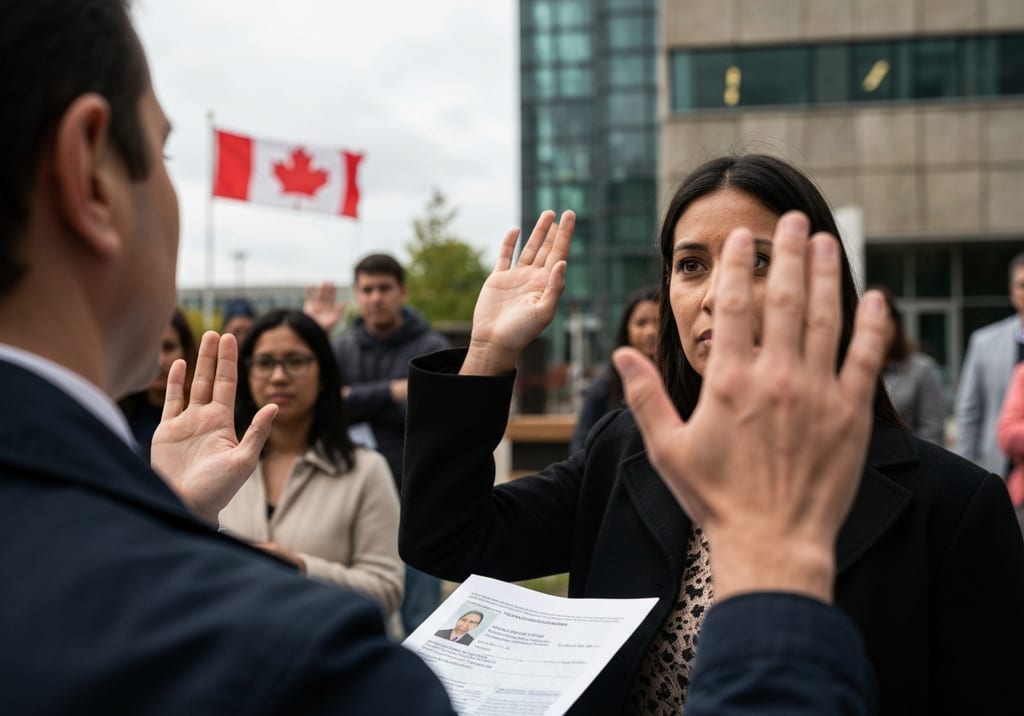
When you're ready, the basic path looks like this: confirm your eligibility (especially the day count), gather your documents, complete the application package, and pay the required government fees. A processing fee applies, and for adults there's also a right-of-citizenship fee, but the exact amounts change periodically, so confirm the current totals on the official IRCC website rather than relying on a figure you saw secondhand. After you apply, you'll typically be asked to complete the test and an interview if applicable, and successful applicants are invited to take the oath of citizenship, the final step that makes it official.
Because processing times shift constantly, treat any timeline you hear as a rough idea only and check the current estimate directly with IRCC. The single best move you can make today is to run your dates through the official physical presence calculator, so you apply on a date you're genuinely eligible, not a guess.