
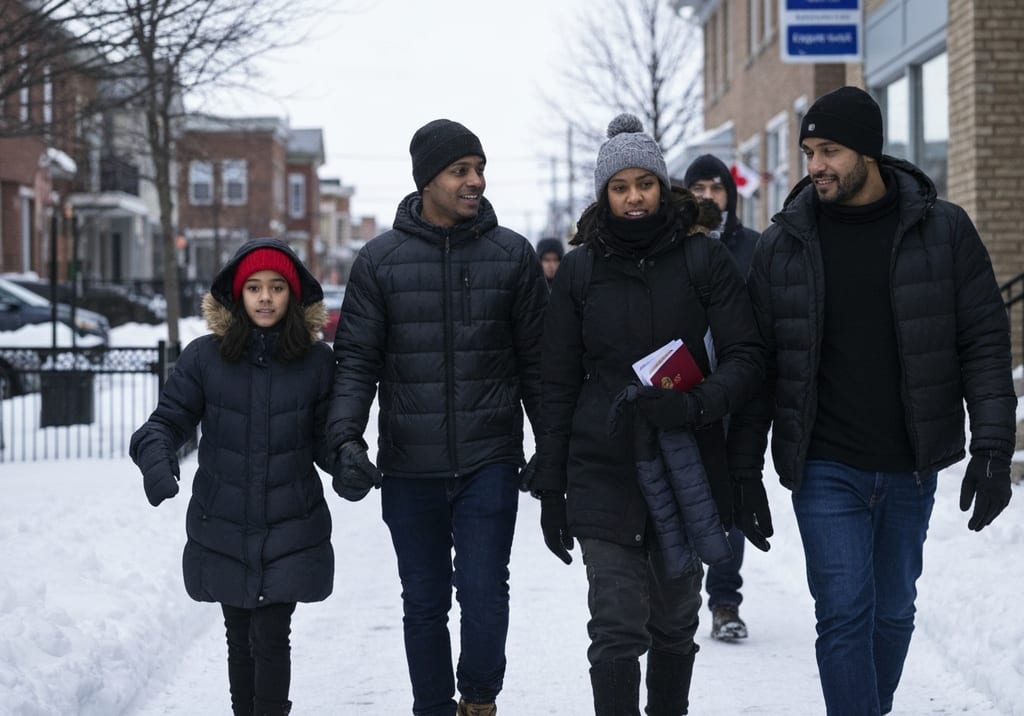
After You Become a Permanent Resident: Settlement Services and First Steps
TL;DR — After landing in Canada as a permanent resident, newcomers should immediately apply for a Social Insurance Number (SIN), enrol for provincial/territorial health insurance, open a bank account, get a driver's licence (or temporary equivalent), find housing, and connect with IRCC-funded settlement service providers. Free settlement services include language classes (LINC/CLIC), needs assessments, employment counselling, and community orientation. Tax filing is required even with no Canadian income, and credit history must be built locally.
At the port of entry
Newcomers arriving as permanent residents complete a final landing interview with the Canada Border Services Agency (CBSA). The CBSA officer:
- Verifies identity and Confirmation of Permanent Residence (COPR).
- Asks about goods imported and money carried (CAD $10,000+ must be declared).
- Issues the official PR landing record.
The PR card is then mailed to the address provided within 30 days of landing. New PRs without a confirmed Canadian address at landing have 180 days to update their address through the IRCC online portal.
Immediate first steps (week 1)
1. Apply for a Social Insurance Number (SIN)
The SIN is a 9-digit number required to work in Canada or receive government benefits. Newcomers can apply at any Service Canada office with their PR confirmation, passport, and birth certificate (if available). Most SINs are issued same-day. There is no fee.
2. Enrol for provincial/territorial health insurance
Every province and territory administers its own publicly funded health insurance plan (OHIP in Ontario, RAMQ in Quebec, MSP in BC, AHCIP in Alberta, etc.). Newcomers should apply within 14 days of arrival. Some provinces have a 3-month waiting period — during that time, private travel medical insurance is recommended.
3. Open a bank account
Major Canadian banks (RBC, TD, BMO, Scotiabank, CIBC, National Bank, Desjardins, plus newcomer-focused offerings like Tangerine, Simplii, EQ Bank, Wise, and Vancity) offer newcomer accounts that waive fees for the first year and accept newcomer ID. Required documents typically: passport, PR card or COPR, two pieces of secondary ID.
4. Find housing
Newcomers can search for rental housing on canadian platforms (Realtor.ca, Padmapper, Kijiji, Facebook Marketplace, Zumper). Most landlords require Canadian credit history; newcomers can substitute with prepaid rent (often 6–12 months), employer letter, or a Canadian-resident guarantor.
5. Get a Canadian driver's licence
Driving rules vary by province. Most provinces let new arrivals drive with a foreign licence (with an International Driving Permit) for 60 to 90 days, then require a provincial licence. Some countries have reciprocity agreements (e.g., UK, US, Japan, Germany) that allow direct exchange. Otherwise, newcomers must take vision tests, knowledge tests, and road tests under the provincial graduated-licensing system.
IRCC-funded settlement services
IRCC funds the Settlement Program through agreements with more than 550 service-provider organizations across Canada (excluding Quebec, which administers its own programs through MIFI). Services are free for permanent residents, protected persons, and refugees, and remain available until the newcomer becomes a Canadian citizen.
Six main service areas
- Needs and assets assessment: a settlement worker meets with the newcomer to identify needs, language level, employment goals, and connect to other services.
- Information and orientation: workshops on Canadian society, how government works, rights and responsibilities, and how to access services.
- Language assessment: free Canadian Language Benchmarks (CLB) assessments through CLARS (Centralized Language Assessment and Referral Service).
- Language training: Language Instruction for Newcomers to Canada (LINC) for English, or Cours de langue pour les immigrants au Canada (CLIC) for French. Free for PRs at all CLB levels (1–8).
- Employment-related services: resume help, mock interviews, mentorship, bridge-training programs for foreign-trained professionals (engineers, nurses, teachers).
- Community connections: peer-mentor programs, conversation circles, social activities, volunteer opportunities to build local networks.
Six support services
- Care for Newcomer Children (childcare during settlement-program activities).
- Transportation assistance.
- Translation.
- Interpretation.
- Disability support.
- Crisis counselling.
How to access
Newcomers visit canada.ca's "Find a settlement service near you" tool (ircc.canada.ca/english/newcomers/services/index.asp) or contact a service provider directly. Most provinces have one umbrella organization (OCASI in Ontario, AMSSA in BC, AAISA in Alberta, etc.) that lists local agencies.
Tax filing
All Canadian residents — including new PRs — must file a Canadian tax return for the calendar year they became residents, even if they had no Canadian income. The tax year runs January 1 to December 31; returns are due April 30 (June 15 for self-employed).
Filing is essential to:
- Receive the Canada Child Benefit (CCB) for children under 18.
- Receive GST/HST credits.
- Build a CRA filing history (helpful for future applications, citizenship, and credit).
- Avoid penalties.
The Community Volunteer Income Tax Program (CVITP) offers free tax-clinic help for newcomers with modest incomes.
Building Canadian credit
Most new PRs arrive with no Canadian credit history. Steps to build credit:
- Open a bank account and apply for a secured credit card (cash deposit acts as the credit limit).
- Use the card for small monthly purchases and pay in full each month.
- Avoid carrying balances over the statement date.
- Apply for a small unsecured credit card after 6–12 months of on-time payments.
- Some providers (Borrowell, Koho) offer credit-building tools designed for newcomers.
Canadian credit scores range from 300 to 900. A score above 660 generally qualifies for standard credit products; above 720 unlocks the best rates.
Education for children
Public education is free for children of permanent residents through grade 12. School year runs September to June; enrolment is at the local public school based on home address. Children may need to provide vaccination records, proof of age, and proof of address.
Long-term planning
After the first year, PRs typically focus on:
- Meeting the residency obligation (730 days in 5 years).
- Applying for citizenship (after 1,095 days of physical presence in 5 years).
- Sponsoring family members under family-class sponsorship.
- Renewing the PR card every 5 years.
- Tax planning for foreign income (Canada has tax treaties with most countries to avoid double taxation).
Key facts at a glance
- SIN: free, same-day at Service Canada.
- Provincial health card: 14-day application target; 3-month waiting period in some provinces.
- Free settlement services: until citizenship.
- LINC/CLIC: free language classes, CLB 1–8.
- Tax filing: required even with no income; due April 30.
- Driver's licence: 60–90-day exchange grace period.
- PR card delivery: ~30 days after landing.
- Address update window: 180 days.
Source attribution
This article rewrites public information published by Immigration, Refugees and Citizenship Canada at https://www.canada.ca/en/immigration-refugees-citizenship/services/new-immigrants.html. The original Government of Canada content is licensed under the Open Government Licence — Canada.
Verify on canada.ca
New-immigrant resources and settlement services are updated regularly. Verify on canada.ca: https://www.canada.ca/en/immigration-refugees-citizenship/services/new-immigrants.html.
IRCC.com is an independent news and information aggregator. We are not affiliated with the Government of Canada and do not provide immigration services or advice. For personalized help, contact a CICC-licensed RCIC or a Canadian immigration lawyer.