
Canadian citizenship application 2025: complete guide to physical presence, language, and the citizenship test
Summary — Canadian citizenship is the final step in the Canadian immigration journey for permanent residents (PRs). After meeting the physical presence requirement (1,095 days within the last 5 years), language proficiency (CLB 4 in English or French for ages 18-54), passing the citizenship test, and filing taxes for at least 3 years, eligible PRs can apply for citizenship. Successful applicants receive a Canadian passport, dual citizenship rights (Canada permits dual nationality), voting rights, and the freedom to live, work, and travel internationally as a Canadian. This guide covers the full process from eligibility check to oath ceremony, with 2025 updates and common pitfalls.
Eligibility requirements
To apply for Canadian citizenship in 2025, you must:
1. Be a permanent resident
- Valid PR status at the time of application.
- No outstanding immigration enforcement (removal orders, etc.).
- No conditions on PR (e.g., spouse who arrived as conditional PR before 2017 and didn't comply).
2. Meet physical presence requirement
- 1,095 days (3 years) of physical presence in Canada within the 5 years immediately before the date of application.
- Days as a temporary resident (study/work permit) count as half (max 365 such days).
- Each day in Canada = 1 day as PR; each day as TR before becoming PR = 0.5 day.
- Use the Physical Presence Calculator on canada.ca.
3. File income taxes
- 3 years of taxes within the 5 years before application.
- All required filings with Canada Revenue Agency (CRA) must be in good standing.
4. Demonstrate language proficiency (ages 18-54)
- CLB 4 in speaking and listening in English or French.
- Acceptable proof:
- CELPIP-General, IELTS, PTE Core (English).
- TEF Canada, TCF Canada (French).
- Transcripts from Canadian secondary or post-secondary education in English or French.
- Government-funded language program (LINC/CLIC) certificates.
5. Pass the citizenship test (ages 18-54)
- 20 multiple-choice questions.
- Topics from the official guide "Discover Canada: The Rights and Responsibilities of Citizenship".
- 75% pass rate (15 of 20).
- 30 minutes to complete.
- Originally in-person; now most tests are online from home.
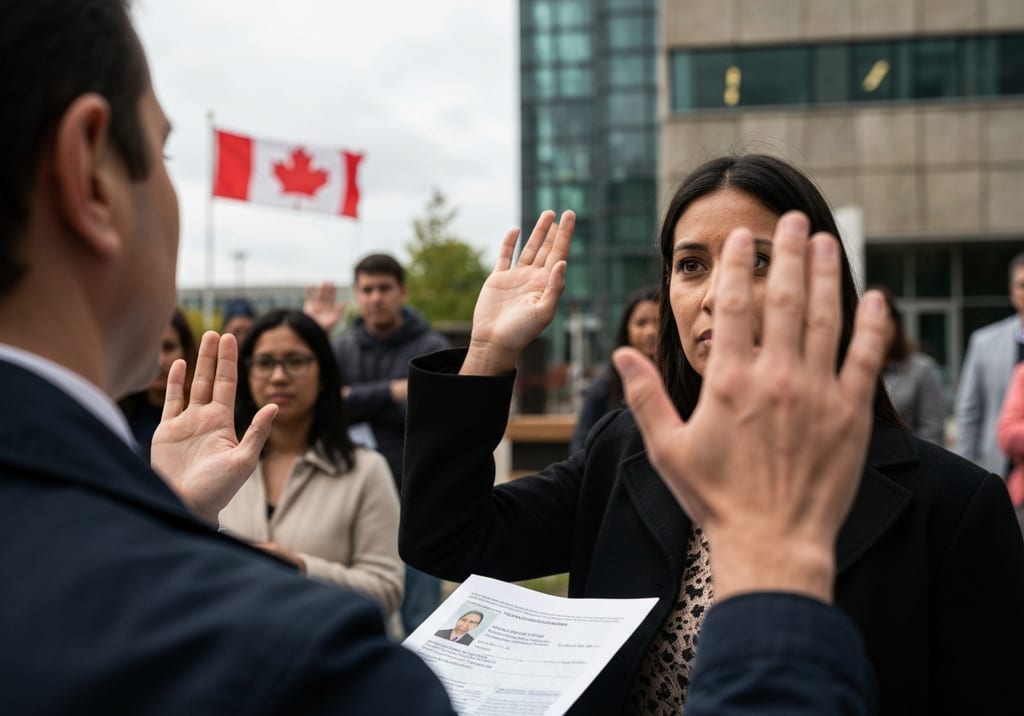
6. Take the oath of citizenship
- Final step in the application process.
- Conducted at a citizenship ceremony (online or in-person).
- Sworn in front of a citizenship judge or commissioner.
2024-2025 updates
Online citizenship test
IRCC has continued online testing as the primary mode. Applicants take the test from home through the IRCC portal.
Online citizenship ceremonies
Most ceremonies are now online via video conference. In-person ceremonies are available on request for special circumstances.
Application fee
- Adult applicants (18+): $630 CAD ($530 processing + $100 right of citizenship).
- Minor applicants (under 18): $100 CAD.
- Adopted children: $100 CAD.
Processing time
- Standard service standard: 12 months from complete application to oath.
- Faster than the 18+ months experienced in 2022-2023.
Step-by-step application process
Step 1: Verify eligibility
- Use the Physical Presence Calculator.
- Confirm tax filings.
- Schedule language test if needed.
Step 2: Gather documents
- Passport(s) covering the 5-year qualifying period.
- PR card / PR status confirmation.
- Travel history (entries/exits, even short trips).
- Tax assessment notices (NOAs) for relevant years.
- Language proof.
- Two passport-sized photos.
- Application fee receipt.
Step 3: Apply online
- Through IRCC portal.
- Complete Application for Canadian Citizenship — Adults (CIT 0002).
- Pay $630 CAD.
- Submit electronically.
Step 4: AOR and Acknowledgement
- Acknowledgement of Receipt (AOR) within ~4 weeks.
- File transferred to a local citizenship office.
Step 5: Test invitation
- Citizenship test invitation sent typically 4-8 months after AOR.
- Online test scheduled at applicant's convenience.
Step 6: Pass the test
- 20 questions on Canadian history, geography, government, rights, responsibilities.
- 75% pass mark.
- If failed, can rewrite once; if failed twice, attend an in-person hearing.
Step 7: Background and security checks
- IRCC conducts checks during processing.
- Adds 2-6 months to total processing.
Step 8: Oath ceremony
- Invitation to ceremony 4-8 months after passing test.
- Online ceremony via video.
- Oath of citizenship taken in English or French.
- Citizenship certificate issued post-ceremony.
Step 9: Apply for Canadian passport
- After receiving citizenship certificate, apply for passport at Service Canada.
- Standard processing: 10-20 business days.
- Passport fee: $160 CAD (10-year, adult).
Common pitfalls
Travel history accuracy
IRCC verifies entry/exit through Canada Border Services Agency (CBSA) records. Any discrepancy in your travel history triggers requests for additional information. Be precise:
- List every trip outside Canada, even short ones.
- Include flight dates, destinations.
- Cross-reference with passport stamps.
Tax compliance
Missing or incorrect tax filings are a major reason for delays. Ensure:
- All 3 of 5 years are filed.
- Self-employment income properly declared.
- Foreign income disclosed (Canadian residents declare worldwide income).
Physical presence shortfalls
- Don't apply with exactly 1,095 days — IRCC requires a buffer.
- Account for partial days (entry/exit days count as full).
- Some people undercount trips home for funerals, weddings, etc.
Language proof issues
- Expired tests (2 years validity for IELTS/CELPIP/TEF/TCF).
- Wrong test type (must be General Training, not Academic for IELTS).
- CLB 4 minimum in speaking AND listening (writing/reading not required).
Conditional PRs
PRs sponsored as conditional spouses (pre-2017) must have completed conditions before applying.
Special cases
Spouses of citizens working abroad
Days accompanying a Canadian-citizen spouse abroad may count under specific conditions (e.g., government employment).
Children born to Canadian parents abroad
- Citizenship by descent: automatic, but limited to one generation beyond original Canadian.
- Apply for citizenship certificate for proof.
Adopted children
- Special pathway: adopted child of a Canadian citizen can apply for direct grant of citizenship.
Stateless individuals
- Specific provisions exist for those without any nationality.
Dual citizenship
Canada permits dual (or multiple) citizenship. Most home countries differ:
- Allow dual with Canada: USA, UK, France, Italy, Brazil, Mexico, Russia (Russia recently withdrew), Pakistan (with restrictions), Egypt, etc.
- Don't allow dual: China, Japan, India, South Korea, Saudi Arabia, UAE, Bangladesh (with conditions), and others.
- Renunciation of original citizenship is the applicant's choice.
Key facts
- Eligibility: 3 years (1,095 days) physical presence in last 5 years.
- Language: CLB 4 (ages 18-54).
- Citizenship test: 20 questions, 75% pass.
- Application fee: $630 CAD adults.
- Processing time: 12 months (service standard).
- Online test and ceremony: standard since 2021.
- Tax filings: 3 of 5 years.
- Dual citizenship: permitted by Canada.
- Right of citizenship fee: $100 (refunded if application unsuccessful).
- Children under 18: $100 application fee.
- Refused applicants: can appeal to Federal Court (judicial review).