
Canadian Citizenship: Eligibility, Application, and the Citizenship Test
TL;DR — Permanent residents become Canadian citizens through a multi-step process: proving physical presence (1,095 days in the 5 years before applying), demonstrating language proficiency in English or French (CLB 4+), passing a citizenship test on rights and responsibilities, filing taxes for at least 3 of the past 5 years, and taking the Oath of Citizenship. The 2026 adult fee is CAD $630 (plus CAD $123 Right of Citizenship Fee). Most applications are now filed online.
Who can apply
To apply for a citizenship grant under the standard adult pathway, applicants must:
- Be a permanent resident (PR) of Canada — PR status must be valid (not under review or in the process of being revoked).
- Have been physically present in Canada for at least 1,095 days (3 years) within the 5-year period before the date of application. Days as a temporary resident or protected person before becoming a PR may count for half-credit, up to a maximum of 365 days.
- Have filed taxes for at least 3 years out of the 5-year period (where required by the Income Tax Act).
- Demonstrate language proficiency in English or French at Canadian Language Benchmark (CLB) 4 or higher (applicants 18–54). Acceptable evidence: language test results, proof of post-secondary education in English/French, or government-funded language program completion.
- Pass the citizenship test (applicants 18–54). The test covers rights and responsibilities of Canadian citizens, Canada's history, geography, government, economy, laws and symbols. The official study guide is Discover Canada — The Rights and Responsibilities of Citizenship.
- Take the Oath of Citizenship at a citizenship ceremony.
- Not be prohibited from citizenship — for example, by criminal convictions, serving a sentence, an active deportation order, or under review for security or human-rights concerns.
Minors (under 18) follow a parallel adult-or-minor pathway and are typically exempt from the language and test requirements.
Recent change: Bill C-3
Bill C-3 (the Act to amend the Citizenship Act, 2025) came into effect in late 2025. It restored Canadian citizenship to most descendants of Canadians born abroad — the so-called "second-generation cut-off" introduced in 2009 was replaced with a substantial-connection test. Affected individuals can now apply for proof of citizenship without having to first become permanent residents.
How to apply
Online application
Most adults and minors apply online through the IRCC online application portal. The application includes:
- Form CIT 0002 (adult) or CIT 0003 (minor) — auto-completed in the online portal.
- Photocopy of identity documents (PR card, passport, driver's licence, birth certificate).
- Two passport-style photos meeting IRCC photo specifications.
- Proof of language proficiency (if 18–54).
- Proof of physical presence (travel history; the IRCC physical-presence calculator is required).
- Tax filing information.
- Application fee.
Paper application
Applicants who cannot apply online (those with disabilities preventing digital filing, or where IRCC has invited paper filing) may submit on paper using the printable forms. Paper applications are mailed to the IRCC Case Processing Centre (Sydney, Nova Scotia).
The citizenship test
The citizenship test is administered to applicants between 18 and 54 years old. It is:
- Online or in-person: Most applicants take the test online during a scheduled session. Some are invited to a hearing with a citizenship officer.
- Format: 20 multiple-choice and true/false questions. Pass mark is 75% (15 of 20).
- Time limit: 30 minutes online (45 minutes for in-person).
- Languages: English or French.
- Content: based on Discover Canada (free download from canada.ca). Topics: rights and responsibilities, history, geography, government, the federation, the economy, justice and laws, Canadian symbols, the Canadian forces, and how to vote.
If an applicant fails, IRCC schedules a second test or a hearing. Two failures usually result in a hearing where a citizenship officer interviews the applicant.
Oath of Citizenship
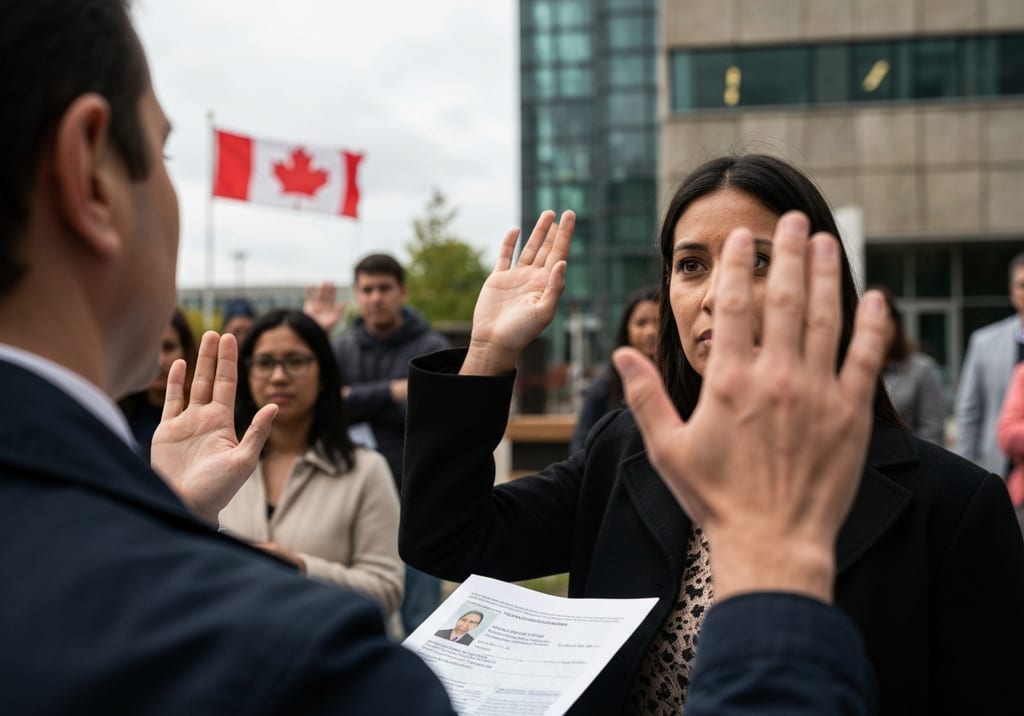
The last step is the Oath ceremony — a formal event where new citizens swear or affirm allegiance to the King of Canada, promise to observe Canadian laws, and pledge to fulfill the duties of citizenship. Ceremonies are held online (since 2020) or in person, often in groups, conducted by a Citizenship Judge or Officer. After the Oath, the new citizen receives a Canadian Citizenship Certificate.
Fees
As of 2026:
- Adult application fee: CAD $630 (processing fee CAD $530 + Right of Citizenship Fee CAD $100; the Right of Citizenship Fee was raised from CAD $100 to CAD $123 effective March 31, 2026).
- Minor application fee: CAD $100 (processing only; no Right of Citizenship Fee for minors).
- Proof of citizenship application (citizenship certificate): CAD $75.
- Search of citizenship records: CAD $75.
Processing times
The IRCC processing-time service standard for adult citizenship grants is approximately 24 months from a complete application to the Oath. Real times vary; IRCC publishes a current estimate on canada.ca. The 24-month service standard is met for the majority of applications.
Dual citizenship
Canada permits dual or multiple citizenship — Canadian law does not require new citizens to renounce other citizenships when they take the Oath. However, some other countries (for example, India, China, Japan) may revoke citizenship automatically when their nationals naturalize elsewhere. Applicants should check their country-of-origin laws.
Loss of citizenship
Canadian citizenship can be lost only through formal renunciation (the citizen must apply to renounce) or revocation (only in very narrow circumstances such as fraud or misrepresentation in the original PR or citizenship application). The 2017 amendments removed citizenship-revocation for dual citizens convicted of treason, terrorism, or espionage.
Key facts at a glance
- Required physical presence: 1,095 days in 5 years.
- Pre-PR days: half-credit, max 365 days.
- Tax-filing requirement: 3 of 5 years.
- Language requirement (18–54): CLB 4 in English or French.
- Citizenship test: 20 questions, 75% pass mark, 30 minutes.
- Adult fee (2026): CAD $530 processing + CAD $123 Right of Citizenship = CAD $653 total.
- Service standard: ~24 months end-to-end.
- Bill C-3 effect: restored citizenship to most descendants of Canadians born abroad.
Source attribution
This article rewrites public information published by Immigration, Refugees and Citizenship Canada at https://www.canada.ca/en/immigration-refugees-citizenship/services/canadian-citizenship.html. The original Government of Canada content is licensed under the Open Government Licence — Canada.
Verify on canada.ca
Fees, processing times, and eligibility rules change. Verify all details on canada.ca before applying: https://www.canada.ca/en/immigration-refugees-citizenship/services/canadian-citizenship.html.
IRCC.com is an independent news and information aggregator. We are not affiliated with the Government of Canada and do not provide immigration services or advice. For personalized help, contact a CICC-licensed RCIC or a Canadian immigration lawyer.