
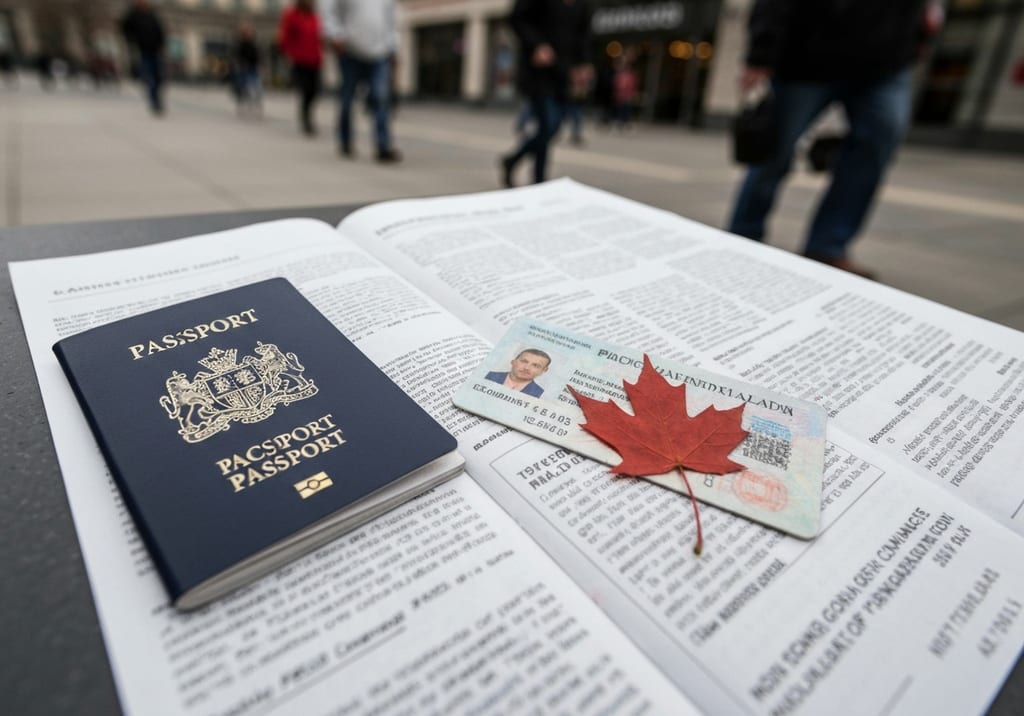
Permanent Resident (PR) Card and the Residency Obligation
TL;DR — A Canadian Permanent Resident (PR) Card is the official wallet-sized identity document that proves PR status. It is required to re-enter Canada on a commercial flight, train, bus, or boat. PR cards are typically valid for 5 years, sometimes 1 year for new PRs without the right documents at landing. To keep PR status, every permanent resident must meet the residency obligation: at least 730 days of physical presence in Canada within any rolling 5-year period. Days outside Canada with a Canadian-citizen spouse or working full-time for a Canadian employer abroad can count.
What the PR card is
The PR card replaced the older paper IMM 1000 "Record of Landing" as the primary proof of PR status in 2002. It is a credit-card-sized plastic card with a photograph, name, date of birth, sex, citizenship, PR card number, expiry date, and machine-readable zone.
A PR card is not required to remain in Canada — once granted, PR status continues regardless of whether the PR holds a valid card. The card is required for re-entry on commercial transport (airline staff at the foreign airport check the card before allowing boarding) and to prove status to employers, landlords, and government services in Canada.
Lost, expired, or expiring PR cards do not affect status, but they prevent commercial re-entry until renewed.
Residency obligation
Under section 28 of the Immigration and Refugee Protection Act (IRPA), a permanent resident must accumulate at least 730 days of physical presence in Canada within every rolling 5-year period. The 730-day requirement applies on every day the PR is outside Canada — IRCC checks the rolling-5-year window when:
- The PR applies for a PR card renewal.
- The PR applies for a Permanent Resident Travel Document (PRTD).
- A border-services officer examines the PR at the port of entry.
Days that count toward the 730
- Each day physically present in Canada counts as 1 day, regardless of immigration category at the time.
- Each day outside Canada with a Canadian-citizen spouse or common-law partner counts as 1 day.
- Each day outside Canada employed full-time by a Canadian business or the federal/provincial public service (assigned abroad) counts as 1 day. The business must be a Canadian-incorporated company actively operating in Canada.
- Each day outside Canada with a parent who is a Canadian citizen (for child PRs) counts as 1 day.
- Each day outside Canada accompanying a PR spouse on assignment for a Canadian business counts as 1 day, provided the PR spouse meets the residency obligation.
Days that do not count
- Days as a tourist or visa-exempt visitor in Canada before becoming a PR.
- Time spent in detention, prison, or a halfway house.
- Time abroad that does not fit one of the special categories above.
Renewal of a PR card
When to renew
IRCC recommends applying 6 months before expiry but allows applications even after the card expires (status itself does not lapse). Renewal must be done from inside Canada — applicants who are abroad with an expired card need a Permanent Resident Travel Document (PRTD) to fly back.
How to apply
- Online: Most PRs apply online through the IRCC portal. Application form IMM 5444 is auto-completed.
- Paper: Available for those who cannot apply online.
- Documents: completed forms, proof of identity, two recent photos meeting IRCC photo specifications, supporting documents proving residency (travel records, T4s, lease, school records).
- Fee: CAD $50.
- Processing time: target 65 days; check the live estimate on canada.ca.
Urgent renewal requests are accepted only with documented evidence (medical emergency, proof of imminent travel for a serious reason).
Permanent Resident Travel Document (PRTD)
A PRTD is a single-use document affixed to the PR's foreign passport that authorizes them to fly back to Canada. PRs apply to the visa office serving the country where they are abroad. The PRTD is for PRs whose card has expired or been lost. Application form IMM 5524.
What happens at the border
A Canada Border Services Agency (CBSA) officer can examine any PR at the port of entry. If the officer suspects the PR has not met the residency obligation, the officer can:
- Refer the PR for a closer review of travel history.
- Issue a Section 44 Report if non-compliance is found, recommending loss of PR status.
- Refer the case to the Immigration Division of the Immigration and Refugee Board (IRB) for a determination.
The PR may appeal a loss-of-status decision to the Immigration Appeal Division (IAD) of the IRB on humanitarian and compassionate grounds.
Voluntary renunciation
A PR who no longer wishes to keep status can voluntarily renounce by applying with form IMM 5782. Renunciation is final and irreversible — to return as a PR later requires a new PR application.
Common pitfalls
- Long stays abroad without counting: many PRs spend years outside Canada thinking they will simply renew their PR card later. Without 730 days of physical presence, the renewal will be denied and a Section 44 Report can be issued.
- Misunderstanding "with a Canadian spouse": only days with a Canadian-citizen spouse abroad count, not a PR spouse.
- Trip-tracking gaps: applicants must list every trip out of Canada in the past 5 years. Missing trips can be flagged.
- Expiry mistaken for status loss: a PR with an expired card is still a PR. Status is lost only by formal revocation, voluntary renunciation, becoming a Canadian citizen, or by a final IRB or Federal Court determination.
Key facts at a glance
- PR card validity: 5 years (most cases) or 1 year (some new arrivals).
- Residency obligation: 730 days physical presence in any rolling 5-year window.
- PR card renewal fee: CAD $50.
- Processing time: ~65 days.
- Status loss: only by revocation, renunciation, citizenship, or IRB/Federal Court determination — never by expired card.
- PRTD: required to fly back to Canada when abroad with an expired/lost card.
- Eligible days outside Canada: with Canadian-citizen spouse, employed full-time by Canadian business abroad, accompanying PR spouse on Canadian-business assignment, child accompanying Canadian-citizen parent.
Source attribution
This article rewrites public information published by Immigration, Refugees and Citizenship Canada at https://www.canada.ca/en/immigration-refugees-citizenship/services/new-immigrants/pr-card.html. The original Government of Canada content is licensed under the Open Government Licence — Canada.
Verify on canada.ca
Residency-obligation rules and PR card fees change. Verify on canada.ca: https://www.canada.ca/en/immigration-refugees-citizenship/services/new-immigrants/pr-card.html.
IRCC.com is an independent news and information aggregator. We are not affiliated with the Government of Canada and do not provide immigration services or advice. For personalized help, contact a CICC-licensed RCIC or a Canadian immigration lawyer.