
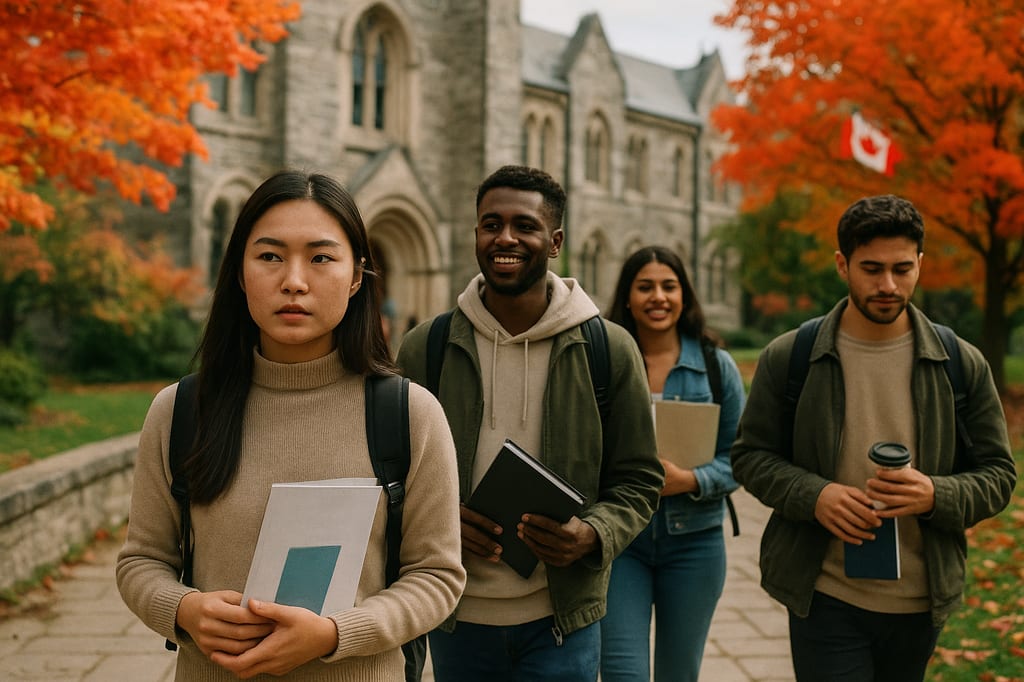
Canada student visa requirements 2026: complete application guide
Canada's study permit rules tightened sharply in 2024 and 2025, and those changes are fully in force for 2026 applicants. The provincial attestation letter is now mandatory for most streams, proof-of-funds thresholds jumped, and processing times vary wildly depending on your country and whether you qualify for the Study Direct Stream. This guide walks through the full document checklist, fees, timelines, and the traps that delay or sink applications.
What documents do you need for a Canadian study permit in 2026?
Every applicant submits a core set of documents. Some streams and countries require extras, but this is the baseline checklist IRCC expects:
Acceptance letter from a designated learning institution. Your DLI issues a letter of acceptance that includes the DLI number—a unique identifier starting with "O" for most institutions. The letter must confirm your program start date, tuition paid or payable, and the credential you'll earn. IRCC cross-checks the DLI number against the official designated learning institution list. Schools that lost DLI status can't sponsor new permits.
Provincial attestation letter (PAL). Most 2026 applicants need a PAL issued by the province where the DLI operates. Master's and doctoral students are exempt, as are applicants extending an existing study permit or switching programs at the same institution. The provincial attestation letter process runs through your DLI. You don't apply to the province directly. Timeline is typically 2–6 weeks after the school requests it on your behalf.
Proof of funds. You must show you can cover tuition for the first year plus living expenses. The 2026 cost-of-living thresholds are higher than in previous years. Expect to demonstrate at least CAD $20,635 for a single applicant studying outside Quebec, plus the full first-year tuition. Acceptable proof includes bank statements from the last four months, a Guaranteed Investment Certificate, scholarship letters, or a sponsor's affidavit with supporting financials. Study Direct Stream applicants must use a compliant GIC from an approved bank.
Valid passport. Must be valid for the duration of your intended stay. If your passport expires mid-program, renew it before applying or IRCC will issue a permit only until the passport expiry date.
Two recent passport photos. Specific dimensions and background requirements apply, covered below.
Biometrics. Fingerprints and a digital photo, collected at a visa application centre. Fee is CAD $85 and biometrics stay valid for 10 years.
Language test results for some applicants. Study Direct Stream applicants must submit IELTS Academic (minimum 6.0 in each band), CELPIP General (minimum 7 in each skill), or TEF Canada (minimum level 7 in each section). Regular-stream applicants don't face a blanket language requirement, but some DLIs require proof of English or French proficiency as part of their admission process. If you took IELTS or CELPIP, the CLB conversion charts show how your scores map to Canadian Language Benchmark levels.
Medical exam, depending on your country. Applicants from certain countries must complete an immigration medical exam with a panel physician before applying. IRCC publishes a list of countries where the exam is mandatory. If you're from one of those places, the exam results are valid for 12 months and must be current when IRCC makes a decision on your file.
Police certificate if requested. Not universally required at the time of application, but IRCC may request one during processing if you lived in another country for six months or more since age 18.
Letter of explanation. A one-page statement explaining why you chose this program, how it fits your career plans, and why you'll return home after graduation. Generic templates fail. Officers look for concrete ties to your home country—family, property, job offers, business interests—and a logical academic progression.
Custodian declaration for minors only. If you're under the age of majority in the province where you'll study, you need a notarized custodianship declaration signed by a Canadian adult and your parents.
The full application guide is at canada.ca/study-permit, with detailed instructions in Guide IMM 5269. Missing a single document from the checklist triggers an incomplete-application refusal. There's no second chance to submit it later.
Provincial attestation letter: who needs one and how to get it
The PAL requirement rolled out in stages through 2024 and became universal for most streams in 2025. In 2026, undergraduate and college students applying for a new study permit need one. So do post-graduate certificate and diploma students, language-program students at private colleges, and applicants switching to a new DLI even if they already hold a study permit.
Master's and doctoral students are exempt. So are students extending a permit at the same DLI and elementary and secondary school students in some provinces, though rules vary.
Your DLI requests the PAL from the provincial government after you accept your offer and pay a deposit. The province issues the letter to the school, which forwards it to you. You upload the PAL with your study permit application. Timeline depends on the province. Ontario and British Columbia process PAL requests faster than Quebec, where delays of 6–8 weeks are common in peak application season.
The catch: each province receives a fixed allocation of PALs under the federal cap on new international students. Once a province exhausts its allocation, no more letters issue until the next intake year. In 2025, several smaller provinces hit their cap by March, leaving late applicants without a path forward. The provincial attestation letter guide covers the mechanics and what happens if your DLI can't secure one.
Proof of funds and tuition payment rules
IRCC wants to see that you can afford the program without working illegally or dropping out mid-year. The baseline for a single applicant studying outside Quebec in 2026 is CAD $20,635 for 12 months of living expenses, plus your first year's tuition in full. Bringing a spouse? Add another $4,000. Each dependent child adds $3,000. Quebec has its own slightly higher threshold.
Bank statements from the last four months showing the required balance count as acceptable proof. So does a GIC from a participating Canadian financial institution—mandatory for SDS applicants, optional for others. An educational loan approval letter stating the disbursement amount and that funds are available for your use works. Scholarship or bursary letters from the DLI or a recognized funding body are fine. A notarized affidavit from a sponsor, usually a parent or relative, with their bank statements and proof of income also qualifies.
The money must be liquid and accessible. Real estate valuations, business ownership stakes, and retirement accounts don't count unless you can show you've liquidated them into cash.
Some DLIs require full first-year tuition upfront before issuing the acceptance letter; others accept a deposit. IRCC doesn't mandate upfront payment for regular-stream applicants, but Study Direct Stream candidates must pay at least one term's tuition before applying. The receipt goes in your application package.
If you're applying through SDS, you must open a GIC of CAD $20,635 with a participating bank. The bank issues a certificate confirming the deposit, which you upload with your application. The funds release in installments after you arrive in Canada. Regular-stream applicants can use a GIC as proof of funds but it's not required.
The 2026 financial requirements breakdown walks through the math for different family sizes and what documentation each proof type needs.
How much does a study permit cost and how long does it take?
The study permit application fee is CAD $150. Biometrics cost CAD $85, valid for 10 years. If you gave biometrics for a previous Canadian visa within the last decade, you don't pay again. If you're applying for an open work permit for your spouse at the same time, add CAD $155 plus a CAD $100 open-work-permit holder fee.
Total for a single applicant with no prior biometrics: CAD $235. Add passport photos, medical exam (CAD $200–$400 depending on the country), and courier fees if your visa office requires you to mail your passport for visa stamping.
Processing times vary by country and stream. Study Direct Stream applicants from the 14 eligible countries typically see decisions in 20 calendar days if the application is complete. Regular-stream timelines range from 4 weeks for applicants from low-risk countries with strong documentation to 16 weeks or more for applicants from countries with high refusal rates or complex financial situations. India-specific processing times sit around 8–10 weeks for SDS and 12–14 weeks for regular stream in early 2026.
Incomplete applications slow things down. So do requests for additional documents mid-processing, security screening for applicants with military service or government employment history, and medical exam delays. Applying during peak season—May through July for September intakes—adds 2–4 weeks to the timeline because visa offices are backlogged.
If you're already in Canada on a visitor visa or another temporary status and want to apply for a study permit from inside the country, different rules apply. See the study permit extension guide for the mechanics of implied status and when you can start studying before the permit is approved.
Photo and biometrics requirements
IRCC requires two identical passport photos taken within the last six months. They must be 35 mm wide by 45 mm high, with a plain white or light-colored background. Neutral expression, mouth closed, eyes open and visible. No glasses, even if you normally wear them. Head covering allowed only for religious reasons, and your full face must be visible from hairline to chin. No shadows on your face or the background. Photos must be printed on photo-quality paper; printouts from a home inkjet printer are rejected.
The back of one photo must include the photographer's name, address, and the date the photo was taken, plus your name and date of birth written in pen. Most passport-photo services know the IRCC specs. Bring the spec sheet if using a generic photo booth.
Photos older than six months get rejected. So do photos with visible shadows, glasses still on, head tilted, smile showing teeth, or low-quality paper. A rejected photo doesn't kill your application outright, but IRCC will request new ones and that adds 2–3 weeks to processing.
You give biometrics—fingerprints and a digital photo—at a visa application centre in your country. Book an appointment after you submit your online application and receive a biometrics instruction letter. The appointment takes 10–15 minutes. Biometrics are valid for 10 years. If you gave them for a previous Canadian visa, work permit, or study permit since 2018, you don't need to give them again unless the 10-year window expired.
Language test and medical exam: when you need them
Language tests are mandatory for Study Direct Stream applicants. IELTS Academic requires 6.0 in each of the four skills: Listening, Reading, Writing, Speaking. CELPIP General requires 7 in each of the four skills. TEF Canada requires level 7, which means a score of at least 249 in each component.
Test results must be less than two years old at the time you apply. The CELPIP scoring guide explains how CELPIP's 1–12 scale maps to CLB levels, and the IELTS-to-CLB chart does the same for IELTS bands.
Regular-stream applicants don't face a blanket IRCC language requirement, but your DLI likely required proof of English or French proficiency as part of the admission process. If you already took a test for admission, the same results satisfy IRCC if you're asked to provide them.
Medical exams are country-specific. IRCC maintains a list of countries where residents must complete an immigration medical exam before applying for a study permit. The list includes most of Africa, parts of Asia, and some Latin American countries. If you're from one of those places, you book an appointment with a panel physician—IRCC provides the list—complete the exam, and the physician uploads the results directly to IRCC. The exam includes a chest X-ray, blood work, and a physical. Cost is typically CAD $200–$400.
Results are valid for 12 months. If IRCC doesn't make a decision on your study permit within that window, you'll need to redo the exam. The exam itself takes 1–2 hours, but results can take 2–3 weeks to upload, so book early.
If you're not from a designated country, you don't need a medical exam unless IRCC specifically requests one during processing. That's rare, but it happens if you declare a medical condition on your application or if you're applying to study in a health-sciences program with clinical placements.
Official current rules are at canada.ca/immigration; this guide is independent reference content.