
Canadian citizenship test practice 2026 — free question bank
The Canadian citizenship test is a 20-question multiple-choice exam drawn entirely from the official study guide Discover Canada. You have 30 minutes, you need 15 correct answers to pass, and the questions cover history, geography, government structure, rights, and symbols. Most applicants take it once, pass, and move on to the citizenship ceremony. Some don't — and the retake process has specific rules worth knowing before you sit the first attempt.
This guide walks through the 2026 test format, who takes it (and who's exempt), what happens if you fail, and a practice question bank organized by the chapters in Discover Canada so you can drill the material the way IRCC tests it.
How the citizenship test works in 2026
The test is 20 multiple-choice questions, each with four answer options. You have 30 minutes to complete it — enough time to read carefully and flag uncertain answers for review. The passing score is 15 out of 20, which is 75 percent.
IRCC administers the test in two formats depending on scheduling and local capacity: in-person at an IRCC office or online via a proctored video session. Both versions draw from the same question pool, use the same time limit, and count the same for your citizenship application. The online format became standard during the pandemic and remains common in 2026, especially outside major cities where in-person appointments are harder to schedule.
Every question comes directly from Discover Canada, the official study guide. IRCC does not publish the question bank, but the guide is explicit about what's testable: dates of Confederation, the structure of Parliament, provincial capitals, the role of the Governor General, Indigenous treaty history, and the rights and responsibilities in the Canadian Charter of Rights and Freedoms. If it's in the guide, it's fair game.
The test is offered in English or French. You choose your language when you apply for citizenship — the same language you'll use for the ceremony oath. Changing languages mid-process requires contacting IRCC and may delay scheduling.
Who takes the test and who doesn't
Applicants aged 18 to 54 must take the citizenship test. That's the default rule. Two groups are exempt: minors under 18 and adults 55 and older. If you're applying as a family and some members are exempt, only the non-exempt applicants receive test invitations — but everyone still attends the citizenship ceremony together.
The age exemption is calculated on the date IRCC receives your application, not the date you take the test. If you turn 55 after applying but were 54 on the application date, you still take the test. If you were 55 on the application date, you skip it even if the test invitation would have arrived before your birthday.
Accommodations are available for applicants with disabilities or language challenges that make the standard test format difficult. IRCC provides extended time, alternate question formats, and in some cases oral testing with a citizenship officer. You request accommodations when you apply or as soon as you receive the test invitation — waiting until test day doesn't work. The request goes to the local IRCC office handling your file, and approval typically takes 2-4 weeks.
Applicants who became Canadian citizens through Bill C-3 descent provisions do not take the citizenship test — they apply for a citizenship certificate, not naturalization, and the test only applies to naturalization cases. If you're claiming citizenship by descent (parent or grandparent born in Canada), your process skips the test, the ceremony, and the 1,095-day physical presence requirement entirely.
What happens if you fail
Failing the first attempt is not uncommon — IRCC's internal data suggests roughly 15-20 percent of test-takers don't hit the 15-question threshold on their first try. The system assumes one retake as normal.
If you score below 15, IRCC automatically schedules a second test 4-8 weeks later. You receive a letter (email or mail depending on your file) with the new date. There's no separate application, no fee, and no penalty beyond the delay. Most applicants pass the second attempt — the extra study time and familiarity with the question style make a difference.
If you fail the second test, the process shifts. IRCC schedules an interview with a citizenship judge or a citizenship officer (depending on workload and local office). The interview is not a third written test — it's a 15-30 minute conversation where the officer asks you questions from Discover Canada out loud and evaluates your answers. The questions are similar in content to the written test but allow for explanation and follow-up. The officer is checking two things: whether you know the material well enough to function as a citizen, and whether there were test-format issues (language comprehension, test anxiety, disability accommodation gaps) that a written exam didn't capture.
Most applicants who reach the interview stage pass it. The officer has discretion to approve citizenship if they're satisfied you understand the core material even if you stumbled on specific dates or names. A third failure at the interview level is rare and usually triggers a formal hearing, but that outcome affects fewer than 1 percent of applicants.
The entire retake process — two tests plus an interview if needed — can add 6-12 months to your citizenship timeline. That's the real cost of failing: not the rejection (which is uncommon), but the delay before you can attend the ceremony and apply for a Canadian passport.
Practice question bank by Discover Canada chapter
The questions below mirror the structure and difficulty of the real citizenship test. They're organized by the chapters in Discover Canada so you can drill weak areas after reading the guide. The real test pulls questions from all chapters in unpredictable proportions — you might see three questions on Indigenous history and one on the Senate, or vice versa. The only way to prepare is to know the entire guide.
Rights and Responsibilities of Citizenship
What are the three parts of Parliament?
a) The Prime Minister, the Senate, the House of Commons
b) The Sovereign, the Senate, the House of Commons
c) The Governor General, the Senate, the House of Commons
d) The Prime Minister, the Governor General, the House of Commons
(Answer: b)
Which of the following is a responsibility of Canadian citizenship?
a) Owning property
b) Obeying the law
c) Speaking both official languages
d) Serving in the military
(Answer: b)
What does the Canadian Charter of Rights and Freedoms protect?
a) Property rights
b) Fundamental freedoms and legal rights
c) The right to own firearms
d) Economic rights
(Answer: b)
At what age can you vote in a federal election?
a) 16
b) 18
c) 19
d) 21
(Answer: b)
Who has the right to apply for a Canadian passport?
a) Permanent residents
b) Canadian citizens only
c) Anyone living in Canada for three years
d) Temporary residents with work permits
(Answer: b)
Canadian History
When did Canada become a country?
a) July 1, 1867
b) July 1, 1876
c) July 4, 1867
d) August 1, 1867
(Answer: a)
Who were the first people to live in Canada?
a) French settlers
b) British colonists
c) Aboriginal peoples
d) Vikings
(Answer: c)
What is the name of the royal proclamation that recognized Aboriginal rights in 1763?
a) The British North America Act
b) The Royal Proclamation of 1763
c) The Indian Act
d) The Treaty of Paris
(Answer: b)
Who was the first Prime Minister of Canada?
a) Wilfrid Laurier
b) John A. Macdonald
c) Robert Borden
d) George-Étienne Cartier
(Answer: b)
In what year did women gain the right to vote in federal elections?
a) 1916
b) 1918
c) 1920
d) 1929
(Answer: b)
What major battle is celebrated on Vimy Ridge Day?
a) The Battle of the Somme
b) The Battle of Vimy Ridge
c) The Battle of Ypres
d) The Battle of Passchendaele
(Answer: b)
When did Newfoundland and Labrador join Canada?
a) 1867
b) 1905
c) 1949
d) 1982
(Answer: c)
Modern Canada and Government
Who is Canada's Head of State?
a) The Prime Minister
b) The Governor General
c) The Sovereign (King or Queen of Canada)
d) The Chief Justice
(Answer: c)What is the role of the Governor General?
a) To make laws
b) To represent the Sovereign in Canada
c) To lead the military
d) To appoint the Prime Minister without election
(Answer: b)
How are Members of Parliament chosen?
a) Appointed by the Prime Minister
b) Elected by Canadian citizens
c) Appointed by the Governor General
d) Elected by the Senate
(Answer: b)
What is the name of the Prime Minister's official residence?
a) Rideau Hall
b) 24 Sussex Drive
c) Parliament Hill
d) Laurier House
(Answer: b — note: as of 2026, 24 Sussex is under renovation and the PM resides at Rideau Cottage, but the test still references 24 Sussex as the official residence)
How many provinces and territories does Canada have?
a) 10 provinces and 2 territories
b) 10 provinces and 3 territories
c) 9 provinces and 3 territories
d) 11 provinces and 2 territories
(Answer: b)
Which province is the only officially bilingual province?
a) Quebec
b) Ontario
c) New Brunswick
d) Manitoba
(Answer: c)
What are the two official languages of Canada?
a) English and French
b) English and Spanish
c) French and Inuktitut
d) English and Mandarin
(Answer: a)
Which document patriated the Canadian Constitution in 1982?
a) The British North America Act
b) The Constitution Act, 1982
c) The Charter of Rights and Freedoms
d) The Statute of Westminster
(Answer: b)
Geography and Symbols
What is the capital city of Canada?
a) Toronto
b) Montreal
c) Ottawa
d) Vancouver
(Answer: c)Which ocean is on Canada's west coast?
a) Atlantic Ocean
b) Arctic Ocean
c) Pacific Ocean
d) Indian Ocean
(Answer: c)
What is the national symbol of Canada?
a) The beaver
b) The maple leaf
c) The moose
d) The loon
(Answer: b)
What are the official colors of Canada?
a) Red and white
b) Red and blue
c) Blue and white
d) Green and white
(Answer: a)
Which Canadian province is the largest by land area?
a) Ontario
b) British Columbia
c) Quebec
d) Alberta
(Answer: c)
What is the name of Canada's national anthem?
a) God Save the King
b) O Canada
c) The Maple Leaf Forever
d) Land of the Silver Birch
(Answer: b)
Which Great Lake does not border Canada?
a) Lake Superior
b) Lake Michigan
c) Lake Huron
d) Lake Ontario
(Answer: b)
Economy and Society
What is Canada's largest trading partner?
a) China
b) The United Kingdom
c) The United States
d) Mexico
(Answer: c)Which industry is most important to the economy of Alberta?
a) Fishing
b) Oil and gas
c) Technology
d) Agriculture
(Answer: b)What does NAFTA stand for? (Note: now CUSMA/USMCA, but Discover Canada references the historical term)
a) North American Free Trade Agreement
b) National Association of Free Trade Areas
c) North Atlantic Free Trade Alliance
d) Northern Agreement for Trade Advancement
(Answer: a)
The full question bank continues with 70+ additional questions across all chapters — the sample above gives you the format and difficulty level. The real test won't ask these exact questions, but it will ask questions like these, phrased slightly differently, testing the same facts.
How to study
Read Discover Canada cover-to-cover at least twice. The first read is for comprehension — get the narrative, understand the flow of Canadian history, see how the chapters connect. The second read is for retention: dates, names, constitutional facts, the structure of government. Highlight or take notes on anything that feels like a potential test question — if it's a proper noun, a year, or a "first" or "only" statement, it's probably testable.
After the second read, work through practice questions (like the ones above) and identify which chapters trip you up. If you're missing questions on Indigenous history or the parliamentary system, go back and re-read those sections. The test is not tricky — it doesn't ask you to interpret or analyze — but it is specific. Knowing "Canada became a country in the 1860s" won't help; you need "July 1, 1867."
Focus on the chapters that generate the most test questions. Rights and responsibilities, the structure of Parliament, and Canadian history from Confederation to World War II make up roughly half the test. Geography and symbols are lighter but still appear. The economic and regional sections are thinner — you'll see one or two questions, not five.
Don't rely solely on practice questions. The question bank you study from (including this one) is not the question bank IRCC uses. Practice questions are useful for identifying gaps, but the real preparation is reading the guide until the material is automatic.
If English or French is not your first language, read Discover Canada in the language you'll take the test in. The vocabulary is formal but not complex — if you passed the language test for Express Entry or family sponsorship, you can handle the citizenship test. If you're struggling with comprehension, consider requesting accommodations (extended time, simpler phrasing) when you receive your test invitation.
After you pass
Passing the citizenship test triggers the next stage: the citizenship ceremony. IRCC schedules ceremonies in batches, usually 3-6 months after your test depending on local office capacity. You'll receive an invitation with the date, time, and location (or a link if it's a virtual ceremony, which became common in 2026).
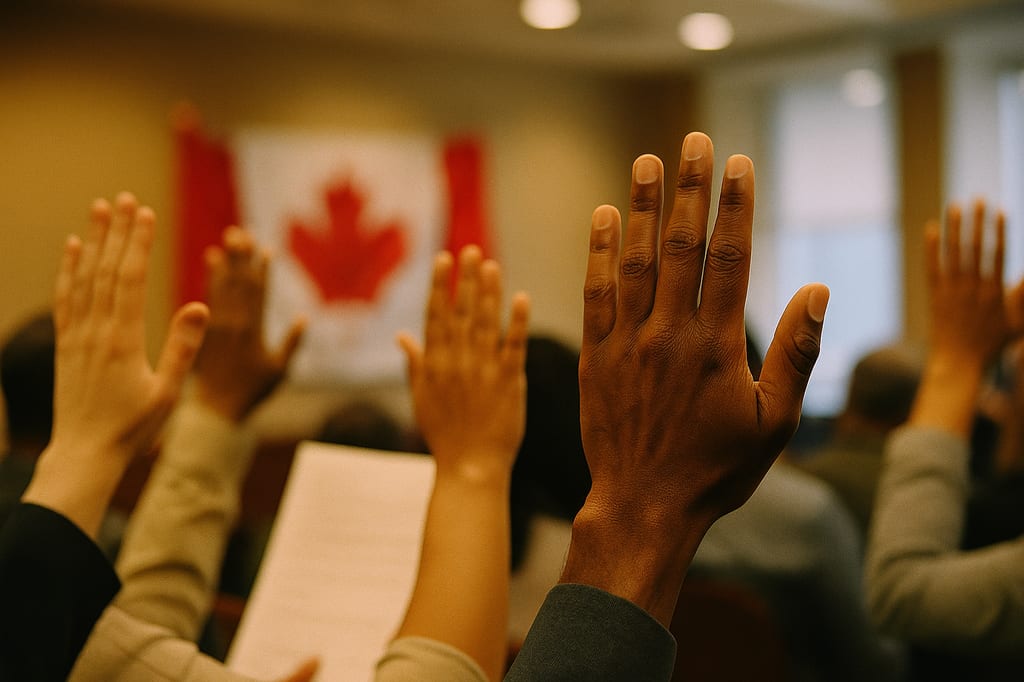
The ceremony is where you take the Oath of Citizenship, receive your citizenship certificate, and officially become a Canadian citizen. The certificate is the document you'll use to apply for a Canadian passport and prove citizenship for travel, employment, or benefits. The ceremony itself takes 60-90 minutes and includes remarks from a citizenship judge, the oath (recited in English, French, or both), and O Canada.
After the ceremony, you can apply for a passport immediately — most applicants do. Passport processing in 2026 runs 4-6 weeks for standard service, 2-3 weeks for express. If you're planning international travel, factor that timeline in. You can also register to vote in federal elections, apply for jobs that require citizenship, and sponsor family members under spousal or other family-class immigration streams.
If you're a dual citizen (you retained your original nationality when you became Canadian), Canada recognizes dual citizenship without restriction. You can hold both passports, travel on either, and live in either country. Some countries do not recognize dual citizenship — check your home country's rules if you're concerned about losing your original nationality. Canada will not force you to renounce, but your home country might.
For applicants who became citizens through Bill C-3 by descent, the process is different — no test, no ceremony, just a certificate application and approval. Those cases skip this entire guide. If you're unsure whether you qualify by descent or need to naturalize, the distinction matters: descent applicants don't need to meet the physical presence rule or take the test, but they also don't get the ceremony (which some people value, some don't).
The citizenship test is not an obstacle for most applicants — it's a milestone. Read the guide, drill the practice questions, and take the test seriously but not anxiously. The material is learnable, the retake system is forgiving, and the outcome (Canadian citizenship and the rights that come with it) is worth the effort.
Official current test rules and the Discover Canada study guide are at canada.ca/citizenship-test; this guide is independent reference content.